high-bay LED retrofit Dallas Fort Worth – DFW runs on warehouse space, and a great deal of that space is still lit by whatever went in when the building was built. High-bay LED retrofit is one of the most straightforward upgrades available to a facility manager — lower draw, longer fixture life, and no more sending a lift out every time a ballast fails.
It is also one of the easiest upgrades to get wrong, because “swap the fixtures” is not the same as lighting the building properly. Here is what actually determines whether a retrofit works.
Start with light levels, not fixtures
The first question is not which fixture. It is how much light the work actually needs. Recommended levels from IES RP-7 vary considerably by task:
- Inactive storage — roughly 5–10 foot-candles
- General warehousing and forklift aisles — roughly 20–30 foot-candles
- Picking and packing — roughly 30–50 foot-candles
- Quality control and inspection — roughly 50–100 foot-candles
OSHA sets minimums, but those minimums sit well below these figures. Meeting the regulatory floor is not the same as lighting a space properly for the work being performed in it — and a facility lit to bare minimum in a picking aisle will feel dim and produce errors regardless of compliance.
Uniformity matters more than raw output
A retrofit that hits its average foot-candle target and still fails is almost always a uniformity problem. Industry practice is to hold a 3:1 average-to-minimum ratio, so light is reasonably even rather than bright under each fixture and dim between them.
Those dark patches between fixtures cause visual fatigue, and in a forklift aisle they are a genuine safety issue. Vertical illumination matters too — rack labels have to be readable on the face of the rack, not just on the floor.
Mounting height decides the fixture
Twenty feet of ceiling height is the usual dividing line between high-bay and low-bay fixtures. Below that, low-bay generally delivers better uniformity and efficiency, so specifying high-bay in a lower building is a common and expensive mistake.
Spacing matters just as much. The spacing-to-height ratio — distance between fixtures divided by mounting height above the work surface — should generally land between 1.0 and 1.5 for LED high-bay. Push past 1.5 and coverage goes uneven, with visible dark patches between fixtures.
This is exactly why one-for-one fixture swaps so often disappoint. LED optics distribute light differently from the metal halide or fluorescent fixtures they replace, so the old layout is rarely the right layout.
Where the money actually comes back
Energy draw is the obvious saving, but the timing of that draw is where the larger number usually sits. Utilities apply demand charges during peak usage periods, and the lighting that runs continuously or through peak windows is what drives them — parking areas, exterior and security lighting, and common areas that coincide with peak demand.
Maintenance is the saving people forget to count. High-bay fixtures are expensive to service precisely because they are high. Every ballast failure is a lift, a technician and interrupted operations. We covered the wider decision in strategic LED retrofits versus full lighting replacement, which is worth reading before you commit to a scope.
What to check before you retrofit
- Existing circuit capacity, and whether panels can accommodate controls
- Compatibility of existing wiring with dimming, switching and emergency backup functions
- Whether emergency and egress lighting is included in scope — it is code-required and often overlooked
- Which circuits actually run during peak demand windows
- Whether the work can be phased around operations rather than requiring a shutdown
That last point matters more in an operating warehouse than anywhere else. Lighting can usually be upgraded zone by zone during planned maintenance windows rather than shutting the floor down.
If the load analysis shows your panels are already at capacity — common in older buildings now carrying added HVAC, equipment and EV charging — a commercial panel upgrade may need to come first.
Leasing a new warehouse or flex space instead of upgrading the one you have? Lighting is only one piece of the electrical scope. Our guide to tenant finish-out electrical in DFW covers how to plan the panel, power and lighting together before you sign the lease.
Retrofits across the DFW industrial corridor
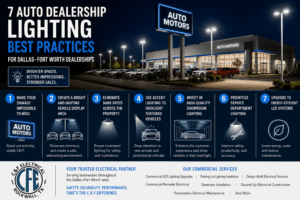
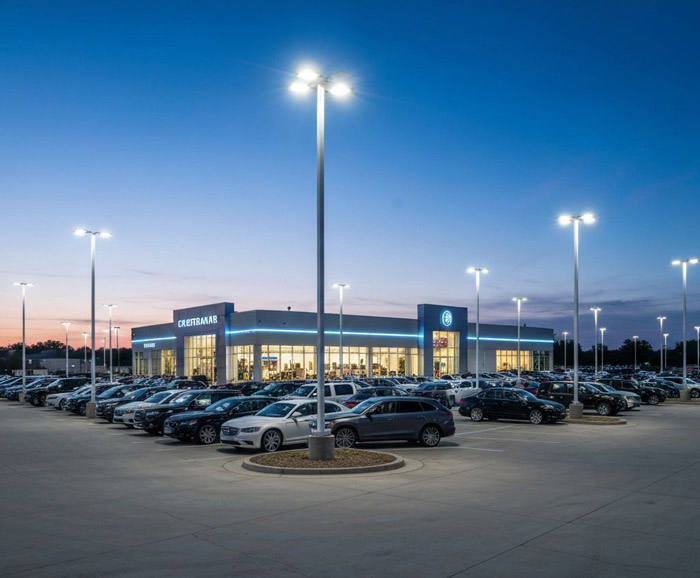
C and F Electrical handles commercial LED lighting installation and retrofits for warehouse, distribution and light-industrial facilities throughout the metroplex, including the I-30 corridor east through Rockwall and Royse City and the wider DFW service area. Different building types bring different problems — for a retail-facing example, see our notes on auto dealership lighting best practices.
High-Bay LED Retrofit Dallas Fort Worth Warehouse LED lighting — common questions
How many foot-candles does a warehouse need?
It depends entirely on the task. IES RP-7 guidance runs roughly 5–10 foot-candles for inactive storage, 20–30 for general warehousing and forklift aisles, 30–50 for picking and packing, and 50–100 for quality control and inspection. OSHA minimums sit below these levels, so meeting the regulatory floor does not mean the space is lit properly for the work.
Can I just swap my existing high-bay fixtures for LED one-for-one?
Often you can, but it frequently underperforms. LED optics distribute light differently from the metal halide or fluorescent fixtures being replaced, so a layout designed for the old fixtures rarely produces even coverage with the new ones. A proper retrofit checks spacing-to-height ratio and uniformity rather than assuming the existing positions are correct.
What ceiling height needs high-bay rather than low-bay lighting?
Twenty feet is the usual dividing line. Below roughly 20 feet, low-bay fixtures generally give better uniformity and efficiency. Specifying high-bay in a lower building is a common and costly mistake.
Will a lighting retrofit shut down my warehouse?
It should not. In an operating facility the work is normally phased zone by zone, or carried out during planned maintenance windows, so the floor keeps running. We coordinate around your operating schedule and with other trades on site.
Do LED retrofits reduce demand charges as well as energy use?
They can, and that is often the larger number. Utilities apply demand charges during peak usage periods, so the lighting that runs continuously or through peak windows — parking areas, exterior and security lighting, common areas — is what drives them. A load analysis identifies which circuits are actually contributing to peak demand.
Get your warehouse lighting assessed
C and F Electrical is a commercial-only electrical contractor serving the Dallas–Fort Worth metroplex since 1977. We walk the building, measure what you actually have, and quote a retrofit built around your light-level targets rather than a fixture count. Call (972) 771-1131 Monday–Friday, 7:00am–5:00pm, or request commercial electrical services. Texas Electrical Contractor License TECL #18170.